Showing posts with label joe morris. Show all posts

Friday, December 18, 2015

Slobber Pup, Pole Axe

Slobber Pup? Hell, yeah! They come front and center with their second album, Pole Axe (Rare Noise). It is the potent pairing of guitarist Joe Morris, keyboardist Jamie Saft, drummer Balasz Pandi, and for this outing the saxophonics of Mats-Olof Gustaffson.

The Rare Noise label favors some heatedly outside electric music and Slobber Pup makes some of the best such sounds of any outfit going. The potent combination of the plugged-in versions of Joe Morris and Jamie Saft and the sheer viscerality of Mats-Olof Gustaffson joined with the creatively out percussives of Balasz Pandi...all this portended some great music when I put the music on my machine. I certainly was not disappointed.

One of my very first musical mentors was right to remind me long ago that, as much as technical and instrument-specific abilities that you must learn in your early days is crucial, it ultimately has to fit properly into a group context if you are going to play music in your life. Nobody thrives much doing nothing but unaccompanied solos...except perhaps Cecil Taylor, but that's another story. And even he gets a group together much of the time. And face it, the solo piano is complete in itself if the player is exceptional. Not to put down the many excellent unaccompanied solo efforts of avant improvisers out there since the early '70s either. Just a general truth.

And so Slobber Pup combines some very potent players who work together to create a very cosmic group sound, filled with virtuosity now and then but also working to achieve a special blend of free electrics that is much more than a collection of solos and accompaniment. I suppose you could say at times that all are soloing at once, yet there is a lot of attention to achieving four-way torque.

On the other hand you get moments when Joe Morris lets his special outside ability fly in the wind overtop the maelstrom, with some of his best cranked playing ever.

So you guitarists reading this should take note--what he is doing here is a product of a great deal of hard work, years of finding his own voice, and then a long time interacting with others in ensembles, finding the give-and-take.

And that is certainly true of everybody in Slobber Pup. It's hard to sound like this with the sort of edge-of-the-universe virtuosity that is a good deal harder to achieve than some of the mainstream normalities. I don't mean playing on changes; that is an art in itself. I mean that it is very difficult to fly without instruments with consistently artistic results, so to speak, to take off for parts unknown trusting the instinctual freedom you achieve with years of dedicated, sometimes financially un-remunerative, finger busting hard labor and mutual cooperation.

All that goes into this music. And all that helps make this music a deluge of creative overtopping, a fine, fascinating suite of electric excesses and bold sound sculpting.

Bravo! Check this one by all means if you seek to go into musical orbit as a passenger on a first-class spaceship.

Friday, June 12, 2015

The Spanish Donkey, Raoul, with Joe Morris, Jamie Saft, Mike Pride

The trio Spanish Donkey returns to us with a new outing called Raoul (RareNoise RNR054 & RNR054), available as CD or double LP.

It kicks out all the jams with a flourish, thanks to the free metal guitar of Joe Morris, the keyboard densities of Jamie Saft and the brash drumming excellence of Mike Pride.

This in a way is an all-star trio. Each player has that something special and they are determined here to make an album that is free, very dark-metal oriented but with the lucidity of outside jazz inventiveness.

Joe Morris cranks up his guitar and gives it spank and spunk with plenty of sustain and effects. Jamie Saft lays down intensely thick washes of keys that cover all the sonic and frequency possibilities for a heaviness born of a sure sense of sound sculpture. Mike Pride explodes with barrages of freedom appropriate to the heaviness of the music. He is the RIGHT drummer for this trio because he has all the energy, technique and stylistically informed originality going for this music.

Joe Morris shows us he can take his own open approach and make it densely raw and soulfully skronky in a post-Hendrix sort of maelstrom. It is the sort of performance any guitarist in the heavy zone needs to hear closely and learn from. But that's true of the trio as a whole.

This is extreme and extremely satisfying jazz metal with no pretense and pure commitment.

If you like things outside and heavy, this one will lift you up to a very high place. It is a monument in its own way. Everyone should hear it if they can deal with a boldly uncompromising excellence!

Wednesday, April 17, 2013

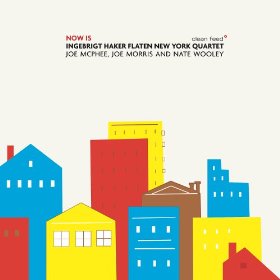
Ingebrigt Haker Flaten New York Quartet, Now Is

When people in the jazz avant camp emerge from the scene gigging and recording with some heavy cats, there is always a reason. Contrabassist Ingebrigt Haker Flaten is certainly one of those lately. And the reason is that he can really play. So when he puts together a disk with some of the heaviest cats, his New York Quartet doing Now Is (Clean Feed 263), it is an affirmation.

Heavy cats? Mr. Joe McPhee on tenor, Mr. Joe Morris on guitar, and Mr. Nate Wooley on trumpet. That qualifies as heavy. Each is a leader on his instrument, a bandleader in his own right, and the melding of all four on a free date is all you'd hope for.

This is a drummerless group, which makes Flaten's bass playing stand out all the more. The result is four equal solo voices engaging in dense free counterpoint.

Everybody is in good form. It's something excellent to sink your ears in.

Friday, November 4, 2011

The Spanish Donkey, "XYX", Joe Morris, Jamie Saft, and Mike Pride


There are organ trios who do what you'd expect in some kind of Jimmie Smith mode. Then there is the Spanish Donkey and their XYX (Northern Spy 009), which is NOT your ordinary trio! It's Joe Morris on guitar, Jamie Saft on keys (and bass guitar) and Mike Pride on drums. What they play is some very engaging super-outside music. If you know Joe Morris's guitar work, you will not be surprised. Yet this is trio freedom with a very thickly textured electronic noise element that goes beyond what Joe usually does. Jamie Saft gets all manner of sound clusters and noisy sustains on the synth keys, Mike Pride plays out of time hefty drums and Joe Morris turns in some of his best work ever. The backdrop that the Spanish Donkey provides seems to stimulate him into an admirable frenzy of note clusters, bends and electric skronk-shreds that get pretty wild.

This is a group effort however--and so the total sound is always an out-front thing. It's heavy music, thick-textured free psychedelics and it is something that once you put it on, you cannot ignore. It will be heard! You either surrender to their web of sounds or you play something else. And really, isn't that the true purpose of getting music for your world? There's no half-heard cocktail party backdrop function that would work for XYX!

What it is is a flat-out blast of fire. It's wonderfully envigorating, like an abrupt dip into an icy stream after several hours in an Indian Sweat House.

Nab this album and you'll be getting a passport to the outer realms of noise-space. Some of the most extreme, but also some of the very best sort of outness!

Tuesday, March 1, 2011

Joe Morris' Solo Bass: "Sensor"


Joe Morris has musicianship to spare. A guitarist on the frontiers of the new jazz, he is also an accomplished contrabassist. So accomplished in fact that he recently did an album of unaccompanied solo improvisations, Sensor (No Business NCLP 27). It's a vinyl LP (a trend I do not find unwelcome incidentally), so the playing time comes in around 35 minutes, and that feels just right.

I do not intend it as a slight when I say that Mr. Morris is probably the best acoustic bassist in the history of improvised music among those who take up the bass as a second instrument. These sorts of comparisons are not terribly illuminating but it gives you some idea what I think of his playing.

To tackle an unaccompanied solo bass album is nervy I suppose, but Joe comes through with a performance that is not only not uninteresting, it is technically proficient and dynamic.

Joe starts off the album with his bass sounding like a Burundian trough zither--earthy, accentuated, punctuated in a freely soulful way. He goes on to bow and pizz his way through extended, long-lengthed line construction in the Joe Morris manner. As with his guitar work, he is never at a loss when constructing a smoothly executed, harmonically extended chromatic phrase.

This is improvised bass music of depth. It is not meant to be a tour de force of pyrotechnical prowess because that's not what Joe is about. Matter-of-factly direct. Avant. This is my music, he seems to be saying. This is what I do.

If you want to hear a player who has forged his playing style out of the force of his musical will, Joe Morris is your man. And Sensor is your album. It's a most pleasant surprise for those like myself that didn't quite expect it. And it will appeal to those who revel in the sonority of the contrabass in a free mode.

Friday, December 10, 2010

Guitarist Joe Morris and the New CD "Camera"


Joe Morris is a horizontal cat. By that I do not mean that he spends his time lying on the couch. It's his improvisation style on guitar. It has extraordinary linear motion. Like a Jackson Pollock canvas he fills out his improvisations in an all-over sort of way. Not from top to bottom so much as from point A to point B. His lines are inventive, harmonically multivalent, continuous and very expressive. It's safe to say that nobody sounds like him. And it's not just that he is note-ful. He constructs melodic cells that not-so-much repeat as they form sets of variations on variations, continually spiraling upwards, to return at each pass in a differing way. And yet it is not cyclical lines he constructs, really. They are horizontal, reaching toward the future.

Well that's my take. Joe Morris is a guitar original. There's no better place to experience his playing than on his latest CD, Camera (ESP 4063). That's a nicely extended live set recorded this year at Phillips Academy in Andover, Massachusetts. Joining him is the equally all-over Luther Gray on drums, plus a kind of string section of Katt Hernandez on violin and Junko Fujiwara Simons on cello.

You get plenty of time to hear the group in action, and the action is quite good. There is a uniqueness to the sound. And for me it's a kind of horizontal experience, a journey in time, an unfolding of avant improvisatory melodic richness.

Joe Morris has created his own musically free zone. Go there on Camera and get transfixed. Don't miss him, especially this new one.

Monday, September 20, 2010

Guitarist Joe Morris, Trumpeter Nate Wooley in "Tooth and Nail" Duets


A CD of all-improvisational duets between archtop guitar and trumpet is not a standard sort of offering. A rather starkly rigorous lineup of this type can be anything from mesmerizing to a raving bore. Thankfully Tooth and Nail (Clean Feed 190) falls closer to the former end of the spectrum than the latter.

Joe Morris, a player who seems to enjoy increasing exposure on disk, cajoles conventional and less conventional sounds out of his microphone-captured archtop guitar while Nate Wooley, another artist getting increasing attention, plays improvisational phrases that unleash an arsenal of techniques and ideas.

Morris and Wooley are exposed to our ears without the cushioning of a rhythm section, and so they face one of the more difficult challenges of the improvising artist. There are no corners to hide in; there are no other players to fill in the gaps and take center stage when the chops or ideas flag.

Both Morris and Wooley show amply on this recording that they have plenty of good improvisational ideas and that their chops are up to the endurance test.

It's helter-skelter, seat-of-the-pants musical performance all the way. Generally Morris and Wooley carry on a varied and contentful dialog with a kind of paralleling double voice rather than a call and response or line and counterline discourse.

In the process they enter rarefied improvisational realms. The music remains on a somewhat abstract level throughout. In that sense this is more or less a purist-modernist outing. Don't expect quotations from "On The Trail" or "BlueTail Fly."

Perhaps this music is not for everybody. Most music isn't. What it IS, it is consistently. It is a high-level example of advanced improvisational duets. And it's a good example of why both Joe Morris and Nate Wooley are getting so much attention lately. They gracefully carry their own weight but they also make that weight the standard by which similar ventures might be judged. In that way Tooth and Nail establishes a kind of standard measure for unconventional duet-ing.

Tuesday, August 10, 2010

Stephen Haynes, Warren Smith, Joe Morris on New CD


Stephen Haynes plays trumpet and fluegelhorn. He's been appearing in the free improv and jazz limelight (such as that is) increasingly it seems. He is joined by double threat drummer/mallet vet Warren Smith and the distinctive guitarist Joe Morris on Parrhesia (Engine 033).

It's a reflective and occasionally boisterous outing that shows Stephen's attention to sound and line to very good advantage. He was one of the late Bill Dixon's students at Bennington and shows the influence in his use of space to surround and punctuate his improvisational poetics. You can hear a little of the later Miles. And there's a certain puckish Lester Bowie-like jabbing of the sound envelope as well. But these are just prefigurations. Warren Smith shows himself as usual to be a great team member in an outing such as this. The drumming is geared toward the sound events and his marimba work adds color and texture. Joe Morris is about as subtle on this one as you are likely to hear. But what he does creates interest and atmosphere.

It's a recording that you can get inside after a few listens. It has a hauntingly pensive quality. The language of freedom in the musical ensemble is used to create stasis and movement, contrast and color.